
Parcel Audit
Parcel Audit Software: A 3PL's Buyer's Guide (2026)
Most audit tools are built for single shippers. A 3PL audits dozens of client accounts at once — and can turn recovery into a client-facing service. What to evaluate, what it costs, and when the math works.
Parcel Audit Software: A 3PL's Buyer's Guide (2026)
Parcel audit software is a tool that automatically checks carrier invoices line by line, flags billing errors, and files refund claims with UPS, FedEx, and other carriers before the dispute window closes. That definition covers what is parcel auditing at its core — this guide is about picking the right tool and deciding whether software alone is the right call for your operation.
The 3PL context changes the calculus. You are not auditing one account — you are auditing dozens of client accounts simultaneously, and the audit function can either be a cost-control line item or a client-facing revenue line. That distinction drives almost every buying decision in this guide.
How does parcel audit software work?
Parcel audit software connects to your carrier accounts via API or EDI, pulls every invoice, and runs each charge through a rules engine that knows what each service is supposed to cost. Discrepancies — a dimensional weight charge that does not match the package dimensions on record, a guaranteed service refund that was never filed, a residential surcharge on a commercial address — get flagged automatically and, in most tools, submitted as claims without manual intervention.
The basic workflow is the same across tools:
- Ingest — the software pulls invoices from UPS, FedEx, and other carriers on a rolling basis, usually daily.
- Match — each charge is compared against your negotiated contract rates, actual package dimensions, and service-level commitments.
- Flag — charges that fail the match (over-billed, ineligible service, late delivery) are queued for dispute.
- File — refund recovery claims are filed within the carrier's window (UPS GSR: 15 calendar days from the scheduled delivery date; FedEx MBG: 15 calendar days from the invoice date).
- Report — credits appear on future carrier invoices; the software tracks them to confirm receipt.
Multi-client account segmentation
For a fulfillment operation, the additional layer is account segmentation. You need the software to tag each shipment to the right client account before any of those five steps run, because the credits ultimately flow through to client billing. Tools that cannot do this cleanly push that reconciliation work back onto your ops team as a spreadsheet problem.
The 7 carrier billing errors worth catching
The real recoverable pool on a carrier invoice is split between two different categories, and they are not equally easy to catch. According to the ShipScience Q2 2026 parcel refund index (vendor-published data, 124M+ shipments), hard carrier billing errors — charges the carrier simply applied incorrectly — account for roughly 0.2–0.7% of parcel spend.
Operational deviations, where the charge is technically correct but the underlying data (dimensions, address classification, service selection) was wrong at ship time, account for another 1.5–3%. The seven error types worth auditing: late-delivery refunds, DIM weight errors, duplicate charges, incorrect zone charges, manifested-but-not-shipped, residential misflags, and surcharge/accessorial errors.
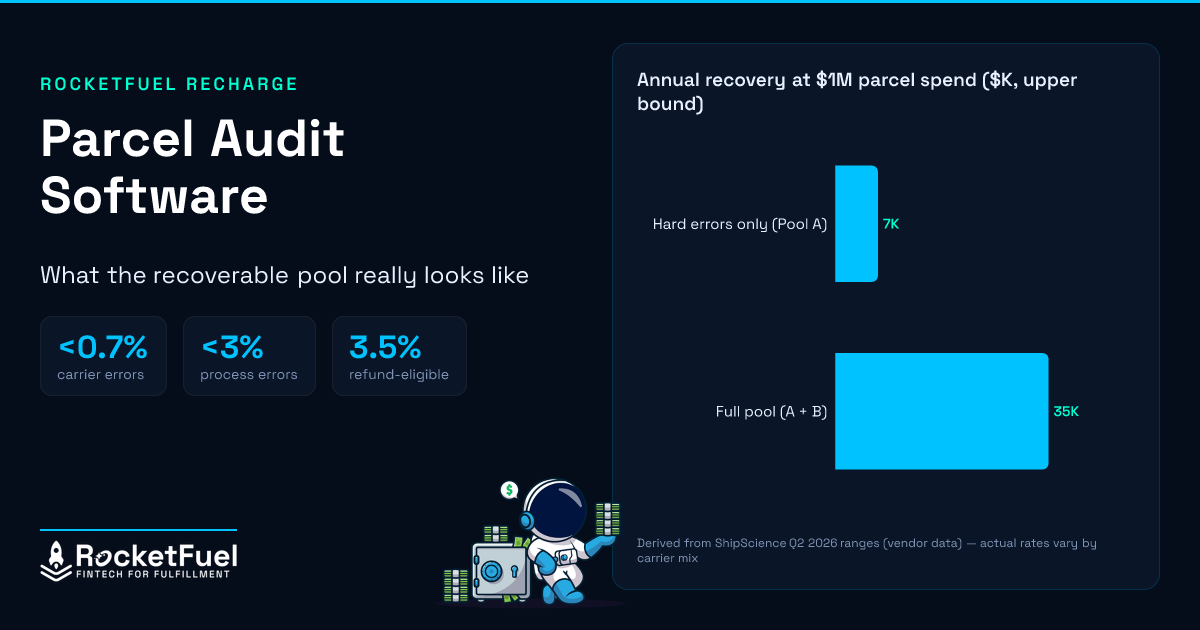
That split matters when you are evaluating a tool. A tool optimized only for guaranteed service refunds is fishing in a very small pond.
Here are the seven error types a complete audit covers, with what to look for on a UPS or FedEx invoice:
1. Late-delivery refunds (GSR / MBG)
UPS calls this the Guaranteed Service Refund; FedEx calls it the Money-Back Guarantee. FedEx reinstated its guarantee for U.S. domestic time-definite services on January 13, 2026 after a holiday-peak suspension — most FedEx Ground and Freight guarantees remain suspended. UPS currently honors its guarantee mainly on premium express tiers; Ground and standard 2nd Day Air are not guaranteed.
The claim windows differ by carrier: UPS GSR claims are due within 15 calendar days of the scheduled delivery date, FedEx MBG claims within 15 calendar days of the invoice date (ship date if prepaid). Check: service commit time vs actual delivery scan, which clock your claim runs on, whether the guarantee was suspended for that lane or service. Note that only roughly 3.5% of total shipment volume runs on guaranteed-service products (ShipScience Q2 2026, vendor data) — late-delivery refunds are real but they are not the largest recoverable category.
2. Dimensional weight (DIM) errors
Both UPS and FedEx use a DIM divisor of 139 for domestic shipments. As of August 2025, fractional inches round up before the formula runs, which inflates billable dimensional weight compared to earlier calculations. The billable weight is the higher of actual weight or DIM weight. Check: does the DIM weight on the invoice match the package dimensions in your WMS? Carriers pull dimensions from their own scan data, which can differ from what you measured at pack.
3. Duplicate charges
The same shipment billed twice — usually caused by a carrier system error or a resubmission glitch. Check: tracking number duplicates within a billing period, charges on voided shipments that were never tendered.
4. Incorrect zone charges
Zone is determined by origin-to-destination ZIP pair. Check: the zone on the invoice against the published zone chart for the origin/destination combination. Zone errors are not common, but when they occur on high-weight shipments the dollar impact is significant.
5. Manifested-but-not-shipped
A label was generated and manifested (scanned at pickup), but the shipment never actually moved. The carrier billed for the label. Check: shipments billed with no subsequent delivery scan.
6. Residential misflags (residential surcharge)
Carriers charge a residential delivery surcharge — applied when the destination is classified as residential in their database. That database is imperfect. Business addresses in mixed-use buildings, suite addresses, and recent commercial conversions all get misclassified regularly. Address correction fees (averaging $18–21 per correction per Lojistic) fall in the same category. Check: destination addresses flagged as residential against your client's known commercial ship-to list.
7. Surcharge and accessorial errors
Accessorial charges — fuel surcharge, additional handling, large package surcharge, peak surcharges — made up 33.3% of UPS parcel spend and 41.9% of FedEx parcel spend for shippers in the index in April 2026 (ShipScience Q2 2026, vendor data). The most frequently disputed are fuel surcharge (applied at wrong tier), additional handling (applied to packages that do not meet the trigger criteria), and large package (dimensions measured differently than contract defines). Check each accessorial line against the current surcharge schedule and your contract thresholds.
Software vs managed service vs DIY
The honest decision frame is not "which option is best" — it is "what does your operation need to do with the audit output."
DIY (manual audit) means an ops lead pulling invoices into a spreadsheet and checking line by line. The seven checks above are the manual checklist — pull each invoice and run them against contract rates and delivery scans.
This is feasible at low volume — roughly under 500 shipments per week — but it does not scale, it misses refund deadlines (catching them requires monitoring every shipment, not just reviewing invoices monthly), and it cannot track credits back to confirm receipt. DIY is not a long-term answer for any 3PL managing multiple client accounts.
Parcel audit software automates the ingestion, flagging, and filing steps. You pay either a SaaS subscription or a contingency fee. The software surfaces the data; your team acts on it. This model works well when you want to own the client relationship and present audit results as part of your reporting stack. For a 3PL, this is also the path to building audit into your client billing as a line item or markup.
Managed services means handing the entire audit function to an outside firm. You get less visibility and less client-facing control, but you also spend zero internal hours on it. If your goal is pure cost recovery and you have no interest in reselling the audit function, a managed provider can make sense. If you want to offer audit transparency to your clients, you need the data in-house. For a comparison of third-party firms, see parcel audit providers.
One boundary worth naming: if you are also auditing LTL or truckload invoices, that is a different category — see parcel vs freight audit software. The claims processes, carrier integrations, and data structures are different enough that most tools specialize in one or the other.
The 3PL buyer's checklist
Most parcel audit software is built for a single-shipper use case: one company, one set of carrier accounts, one invoice stream. For a 3PL, that is the wrong baseline. Here is what to evaluate specifically:
See your recoverable pool
Put your own carrier spend and client mix against the full recoverable pool on a live account.
Multi-client account structure
Can the platform segment shipments by client account before auditing, and tag credits back to the correct account? If you have 30 clients on UPS and FedEx, you need 30 clean account views, not one aggregate dashboard.
Multi-carrier support
UPS and FedEx are the volume carriers, but your clients may also use USPS, DHL, OnTrac, or regional carriers. Verify which carriers the tool actually supports — not which logos appear on the marketing page, but which have live API connections and rules coverage. This is the integration question that separates good small parcel auditing software from tools that require manual uploads for secondary carriers.
WMS and billing integration
The audit output needs to flow somewhere useful. For a 3PL, that is typically your WMS (for dimension/weight validation), your billing system (for client recharge), or both. Confirm the integration is bi-directional: the tool needs to read your shipment data to validate DIM weights, not just read the carrier invoice.
Reporting granularity
Can you run a per-client recovery report, a per-error-type breakdown, and a credit-received-vs-filed reconciliation? Those three reports cover the minimum for client-facing transparency and internal financial close.
Dispute filing automation
Does the tool file claims automatically, or does it surface flags for your team to file manually? For a 3PL auditing across many accounts, manual filing does not scale. Confirm the automation level, and confirm it handles the 15-day window without requiring daily oversight.
Client billing / markup capability
If you intend to resell the audit function — or charge a management fee on recovered credits — does the platform support markup, or does it only report gross recovery? This is a feature most best parcel audit software evaluations ignore entirely because they are written for single-shipper buyers.
Pricing models: contingency vs SaaS
Two pricing models dominate the market, and they optimize for different things.
For most operators starting an audit program, contingency is the lower-risk entry point.
Contingency pricing (also called gain-share) charges a percentage of recovered credits — no recovery, no fee. According to a market estimate from Darrigo Consulting, contingency rates typically run 25–50% of recovered credits; exact rates vary with volume and scope.
Contingency pricing means zero upfront cost and zero fee if the audit finds nothing. The tradeoff: at high recovery volumes, you are paying more than you would under a flat subscription, and the vendor's financial incentive is to find recoverable charges, not to fix the operational issues causing them.
SaaS subscription charges a flat monthly fee (or a fee based on shipment volume), regardless of how much the tool recovers.
This model makes sense when recovery is predictable, when you want to use the platform primarily for spend analytics and reporting rather than pure refund recovery, or when you are packaging the audit cost into a client service fee and need a fixed cost basis. The risk: you pay whether or not the tool finds anything, so the burden of extracting value is on your team.
For most operators starting an audit program, contingency is the lower-risk entry point. For 3PLs that have been auditing for 12–24 months and have a stable sense of their recovery rate, a SaaS subscription often pencils out better on a per-dollar-recovered basis.
Is parcel audit software worth it at your volume?
For an operator, "worth it" means two things: the direct recovery on your own carrier costs, and the client-facing value you can build around the audit function. The ROI math below covers direct recovery only.
The Pool A/B framework
The honest caveat first: the frequently cited "1–5% of parcel spend" recovery figure conflates two very different pools. Using the Pool A/B framework from the ShipScience Q2 2026 index (vendor-published, labeled):
- Pool A (hard carrier errors): 0.2–0.7% of spend — charges the carrier billed incorrectly.
- Pool B (operational deviations): 1.5–3% of spend — charges that are technically correct but were caused by addressable issues (DIM weight driven by packaging choices, residential misflags, wrong service selection) that a complete audit surfaces for correction.
Pool A is recoverable via refunds. Pool B is partially recoverable via disputes but more often corrected through process changes. A tool that only files GSR/MBG claims is fishing in Pool A. A tool that also catches DIM errors, residential misflags, and accessorial misapplications is working the full 1.8–3.5% range.
The table below estimates gross annual recovery for different parcel spend levels. These are ranges, not guarantees — actual recovery depends on carrier mix, shipment profile, and existing error rates.
| Annual parcel spend | Pool A only (0.2–0.7%) | Pool A + B (1.8–3.5%) |
|---|---|---|
| $500K | $1,000–$3,500 | $9,000–$17,500 |
| $1M | $2,000–$7,000 | $18,000–$35,000 |
| $2.5M | $5,000–$17,500 | $45,000–$87,500 |
| $5M | $10,000–$35,000 | $90,000–$175,000 |
| $10M | $20,000–$70,000 | $180,000–$350,000 |
Caveats: (1) These ranges apply the ShipScience Q2 2026 vendor estimates to hypothetical spend levels — your actual rates will differ. (2) Pool B recovery requires operational changes to sustain; you do not capture it by filing claims alone. (3) If you are at under $250K annual parcel spend, the hard math on a SaaS subscription often does not work; contingency pricing or a managed service is more appropriate at that volume.
The other half: carrier cost float
The math above is also only one half of parcel cash flow — money the carriers owe you back. The other half is the carrier cost float: the cash you front for carrier spend between client payments. If the numbers at your volume look marginal, the float side is usually the bigger lever.
Where RocketFuel Recharge fits
RocketFuel Recharge is built for 3PLs, not for individual shippers. The audit function is part of the billing and recharge workflow — when a carrier adjustment lands on a client's account, RocketFuel surfaces it, attributes it, and makes it part of the billing cycle rather than a separate reconciliation task.
Built inside a real 3PL
To date, RocketFuel has caught 28K+ carrier adjustments across client accounts (RocketFuel proprietary data) — spanning both hard billing errors (Pool A) and operational deviations (Pool B), not just refund claims. That number comes from operating inside Launch Fulfillment, a real 3PL, where the audit system was built because we needed it ourselves before we offered it to others.
The practical difference from a bolt-on audit tool: carrier adjustments do not require a separate workflow. They appear in the same place as other billing line items, with client attribution already applied. If you want to present audit results to clients — either as a value-add or as a marked-up service — the data structure supports that without custom exports.
If you want to see how it works on a live account, book a demo.
FAQ
What percentage of carrier invoices contain billing errors?
The answer depends on how you define "error." Hard carrier billing mistakes — charges the carrier applied incorrectly — occur on roughly 0.2–0.7% of parcel spend, according to the ShipScience Q2 2026 parcel refund index (vendor data, 124M+ shipments). When you include operational deviations like packaging-driven DIM weight, residential misflags, and incorrect service selection, the recoverable-plus-saveable pool expands to 1.8–3.5% of spend. Most published "error rate" figures conflate these two pools, which overstates what a pure refund-recovery tool will catch.
Can parcel audit software identify all carrier overcharges automatically?
Most tools automate Pool A — hard billing errors and GSR/MBG late-delivery claims. Pool B errors (dimensional weight miscalculations, residential misflags, accessorial misapplication) require the software to have access to your shipment data, not just the carrier invoice, to detect the gap. If the tool only reads the carrier's billing file, it cannot verify whether a DIM weight charge matches the actual package. Ask vendors specifically whether their rules engine validates against your WMS dimensions or only against carrier-declared data.
How do you choose between parcel audit software and a managed service?
The deciding factor is what you do with the output. If you want to present audit data to clients, integrate credits into client billing, or build the audit into your service offering, you need the data in-house — that points to software. If you want the credits with zero internal effort and have no interest in client-facing audit transparency, a managed service is simpler. Cost is the secondary consideration: contingency applies whether you use software or a managed firm, but managed services typically have higher rates because they absorb all of the labor.
Does parcel audit software work for small 3PLs under $500K in annual parcel spend?
Yes, but the math is tighter. At $500K in annual parcel spend, Pool A recovery runs $1,000–$3,500 per year, and full-pool recovery runs $9,000–$17,500 (ranges derived from ShipScience Q2 2026 vendor estimates). A SaaS subscription has to cost less than those figures to pencil out. At this volume, contingency pricing or a managed service is usually the more practical entry point — and revisiting a SaaS subscription when spend crosses $1M is a reasonable trigger.
More in Parcel Audit
The plain-English definition: how the four-step review works, the error families it catches, and who actually owns the recovered credits in a 3PL relationship.
Parcel Audit · 9 min read Parcel Audit Companies Compared: Pricing Models & Catch RatesThe provider landscape mapped from the public record: managed services vs platforms, the fee math on $1M of spend, and the sample-audit test that beats every brochure.
Parcel Audit · 10 min read Freight Audit Software: Parcel vs Freight & What It CatchesWhat the three-way match catches on LTL bills, how this category is really priced, and the three decision rules that tell you which mode to audit first.
Ready when you are
See it run on your operation.
30-minute live demo. We'll walk your billing model against the Recharge Meter and run the math on your last 90 days.
- Live demo, not a sales deck
- We run your last 90 days
- Built by 3PL operators