
Parcel Audit
Freight Audit Software: Parcel vs Freight & What It Catches
Freight audit earns its keep on LTL and truckload bills, where class and weight rules create errors parcel shippers never see. Most 3PLs searching for it need the parcel side first — here's how to run the fork on your own numbers.
Freight Audit Software: Parcel vs Freight & What It Catches
Freight audit software is a tool that checks freight invoices against contracted rates and shipment data, flagging billing errors for recovery. It earns its keep on less-than-truckload (LTL) and truckload spend, where class and weight rules create errors parcel shippers never see. In our experience, most 3PLs searching for it need parcel audit first.
What does freight audit software do?
Freight audit software compares every freight invoice against two other records — the rate you contracted and the shipment that actually moved — and flags any line where the three disagree. That comparison is called a three-way match: invoice versus shipment versus contract. When the match fails, the platform routes the line for dispute or correction instead of letting it slide through accounts payable.
Audit and payment, defined
The category often trades under a longer name — freight audit and payment, or FAP: audit the carrier invoice, then execute payment on the approved amount, with general-ledger coding attached. The audit half catches errors; the payment half funds only the corrected figure.
Day to day, the work runs in a loop. Capture invoices from EDI feeds and PDFs. Normalize the data. Re-rate every shipment against the contract. Flag the exceptions, then chase each dispute to resolution. The billing errors range from a missed discount to a bill paid twice as a straight duplicate.
Where LTL rating gets hard
The deep end is LTL and truckload freight, where rating is genuinely hard. Price depends on class, weight, distance, discount, and accessorial charges — and any one of those inputs can be wrong on the bill. Manual review at that complexity is slow and inconsistent — which, more than any single error, is why the category exists. On LTL invoices specifically, the errors cluster into class disputes, reweighs, accessorial overcharges, and duplicate billings.
Parcel vs freight audit: which does your mix need?
Parcel auditing and freight auditing check different documents for different failure modes, so the right starting point is whichever mode carries more of your spend and error exposure.
Error families by mode
On the parcel side, the file is thousands of small invoices. The errors live in DIM weight corrections, residential and delivery-area surcharges, and late-delivery refunds owed under the carriers' service guarantees — UPS's guaranteed service refund and FedEx's money-back guarantee.
Both are narrow in scope with short claim windows — and that is all the depth they get on this page. On the freight side, the file is fewer, larger invoices. The errors live in classification disputes, reweighs, and accessorial charges on LTL bills, where one corrected line can outweigh a stack of parcel adjustments.
For sizing the parcel pool: hard carrier billing errors typically run 0.2–0.7% of parcel spend, with another 1.5–3% in shipper-side operational deviations, per the ShipScience Q2 2026 Parcel Refund Index. That is vendor-published data, but it is the most specific public figure available — we haven't found a comparable index for freight.
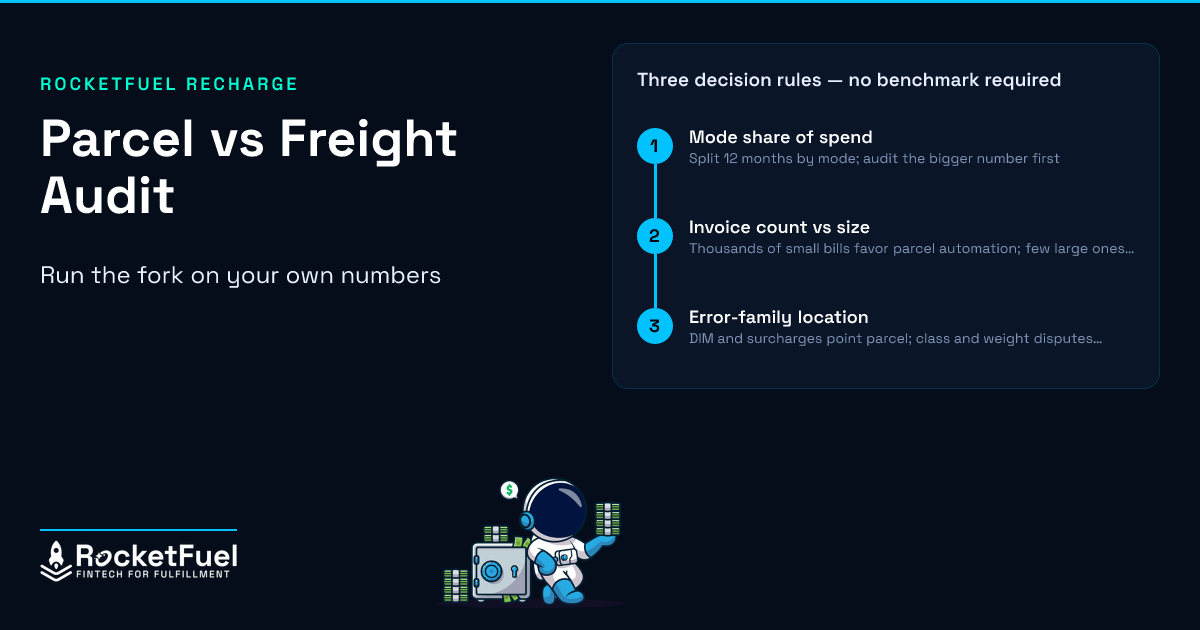
The parcel vs freight audit fork comes down to three decision rules, all run on your own numbers rather than anyone's benchmark:
- Mode share of spend. Split twelve months of transportation spend by mode. Audit the bigger number first.
- Invoice count versus invoice size. Thousands of small invoices favor parcel automation, because no human reviews that volume. A few hundred large invoices favor freight scrutiny, because each line is worth a person's attention.
- Error-family location. If your disputes are DIM corrections and surcharges, your problem is parcel. If they are class changes and weight adjustments, your problem is freight.
The parcel-first default
Most 3PLs typing this search run parcel-dominant operations: outbound DTC volume ships parcel, and freight is mostly an inbound lane. If that is your file, a parcel audit platform recovers more, sooner — freight coverage can wait until inbound spend earns it. Dedicated parcel audit software is its own category, not this page's subject. In the freight platforms we read for this guide, parcel usually appears as a checkbox module — and we would not treat a checkbox as an audit methodology.
RocketFuel Recharge is parcel-first: our audit logic runs at label time, on parcel shipments. We don't sell freight audit, and we won't pretend to.
What freight billing errors does it catch?
Most of what a freight audit flags falls into six families: freight class misclassification, weight and inspection adjustments, duplicate payment, missed discounts, accessorial charges, and fuel surcharge errors.
Freight class misclassification. Every LTL commodity carries a National Motor Freight Classification (NMFC) code, which maps to a freight class — the density-and-handling rating that sets the rate base. A wrong class re-prices the entire line. It happens in both directions: shippers guess low, and carrier inspectors read the NMFC differently than the shipper did.
Reweighs and re-rates. Carriers weigh and measure freight at the dock. When the scale disagrees with the bill of lading, a weight and inspection adjustment — a reweigh, in day-to-day shorthand — re-rates the shipment at the corrected weight or class. These are legitimate when the carrier is right and recoverable when it is not. The audit's job is telling the two apart.
Duplicate payment. The same shipment billed twice — sometimes a straight copy, sometimes re-submitted under a new invoice number after a correction. Without shipment-level matching, the second bill gets paid.
Missed discounts and wrong rate bases. The contracted discount is not applied, or the carrier rates against a different tariff base than your agreement names. Nothing dramatic happens; the invoice is just quietly higher than the contract says.
Accessorial charges. Fees layered on top of linehaul: liftgate service, redelivery, limited-access pickup, and detention — the charge for holding a driver or trailer past free time. Accessorials are the one error family every vendor page names, because they are easy to bill and hard to verify without delivery records.
Fuel surcharge errors. The surcharge comes off a published table tied to a fuel index. Apply the wrong week's table — or the wrong table — and every shipment that week is misbilled by a little.
How big is the whole pool? The most-quoted figure is an average freight invoice error rate of 5 to 8 percent, which appears in Intek's buying guide credited to Inbound Logistics — a secondhand citation, with no primary study named. Treat the range as industry folklore until your own audited invoices say otherwise.
Same mechanism, different paperwork
One worked pair, illustrative only — mechanics, no real dollar figures. The freight line: an LTL shipment tendered at freight class 92.5 gets re-rated to class 125 after a weight and inspection at the carrier's dock. The inspector measured lower density than the bill of lading claimed, so the class moved, and the rate base moved with it — same freight, same truck, higher invoice.
The parcel twin: a package re-billed at a higher DIM weight after the carrier's dimensioner read the box bigger than the label data. Same mechanism in both cases — the carrier re-measured and re-priced. Different paperwork: a re-classed freight invoice line versus an adjustment row on a parcel bill. The audit catches both the same way — hold the bill against the shipment record and the contract.
How freight audit is priced: software vs managed FAP
Expect one of three pricing models — a share of identified savings (gain-share), a per-invoice transaction fee, or a flat subscription — and expect to learn which one only after a sales call.
Audit the bigger mode first
Audit whichever mode carries more of your spend — run the numbers on your own freight-and-parcel mix before you buy tooling for either.
Why posted prices are rare
Public numbers are scarce. The clearest disclosure sits in Loop's vendor roundup, and Loop sells in this market — so this is a vendor describing its competitors and itself; read it accordingly. The roundup sorts the field into service-based, bank-based, and software providers: gain-share pricing at 5–50% of identified savings is the service-based pattern, Intelligent Audit prices per invoice, and Loop itself sells a subscription. A spread that wide means the model name tells you little; the percentage you negotiate is the price.
The history explains why posted prices are rare. Intek's buying guide notes that freight audit and payment providers historically made their money on float — holding the shipper's funds between invoice approval and carrier payment — rather than on a visible transaction fee. Fee models front the public offers now, but the habit of quiet pricing outlived the float.
Where the labor lives
Software versus managed service is really a question of who works the exceptions. Software re-rates invoices and flags disputes; your team files and chases them. A managed freight audit and payment service takes the labor too — audit, dispute, payment execution, ledger coding.
Managed services tend to win when dispute volume is high and the AP team is thin. Software tends to win when you want the data in-house and the fee predictable. Neither outperforms the other in the abstract. The labor has to live somewhere, and you are choosing where.
The parcel side prices differently. Contingency dominates there — typically 25–50% of recovered credits, a market-range estimate from Darrigo Consulting, not a posted rate card. If your fork points parcel, the provider landscape deserves its own comparison: see parcel audit services compared before taking any single quote at face value.
How to choose freight audit software
Evaluate freight audit software on four axes: mode coverage, integration depth, exception reporting, and fee transparency.
A vendor offended by the question has answered it.
Mode coverage. Confirm the platform rates your actual modes — LTL, full truckload, plus whatever drayage or ocean legs feed your inbound — rather than listing them on a logo slide. Ask to watch a re-rate of your own invoices in each mode.
Integration depth. A three-way match is only as good as its inputs. Shipment data should flow from your TMS without a manual export, and approved invoices should post to your ERP with line-level coding. If the vendor's TMS list does not include yours, ask for API documentation rather than a promise.
Exception reporting. A savings dashboard is marketing; an exception report is evidence. Insist on error-level detail — which carrier, which lane, which error family — so the audit changes behavior upstream instead of only collecting refunds downstream.
Fee transparency. Ask for the pricing model on the first call and the effective rate in writing. A vendor offended by the question has answered it.
Let your mix decide
One note from running a fulfillment 3PL, offered as operating experience rather than research. Parcel dominates outbound, because DTC order volume ships as thousands of small parcel shipments each month. Freight shows up inbound, as container drayage and replenishment loads into the warehouse.
In a mix like that, the parcel audit pays first, and the freight file stays small enough to spot-check by hand until inbound volume argues otherwise. Your mix may differ — the point is to let the mix decide, not the category name.
Frequently asked questions
Is there free freight audit software?
Free freight audit software does not exist in any production form. What is marketed as free is usually a sample audit or stripped dashboard tier, built to generate leads for a paid engagement. That is not a knock — a free sample audit of last quarter's invoices is a reasonable way to size your error pool before committing — but plan on a paid model for ongoing use.
Can freight audit software honestly help?
Yes, when freight is a real share of your transportation spend — and the sizing should stay honest. Recoverable errors are a small slice of freight spend, the public error-rate figures are secondhand, and no audit turns billing errors into a profit center. What it reliably delivers: recovered overcharges on carrier invoices, faster invoice approval, and analyst hours back. If your freight file is a few dozen bills a month, a spreadsheet and a sharp AP clerk get you most of the way there.
Do 3PLs need both parcel and freight audit?
Only when both modes carry real spend. Run the parcel vs freight audit decision on your own numbers — mode share of spend, invoice count versus invoice size, and where disputes actually originate. A 3PL with parcel-heavy outbound and a thin inbound freight lane usually gets more back from parcel audit first, then adds freight coverage once inbound spend grows into it.
What does freight audit software cost?
One of three models: a percentage of identified savings, a fee per invoice, or a flat subscription. Posted prices are rare. The one public reference point is Loop's vendor roundup, which puts service-based gain-share pricing at 5–50% of identified savings — and Loop competes here, so weigh it as a vendor describing competitors and itself. Whatever the model, get the effective rate in writing before the demo, not after.
More in Parcel Audit
A buyer's guide written for 3PLs, not single shippers: the seven billing errors worth catching, the two pricing models compared, and the honest ROI math at your spend level.
Parcel Audit · 6 min read What Is Parcel Auditing? Meaning, Process & What It CatchesThe plain-English definition: how the four-step review works, the error families it catches, and who actually owns the recovered credits in a 3PL relationship.
Parcel Audit · 9 min read Parcel Audit Companies Compared: Pricing Models & Catch RatesThe provider landscape mapped from the public record: managed services vs platforms, the fee math on $1M of spend, and the sample-audit test that beats every brochure.
Ready when you are
See it run on your operation.
30-minute live demo. We'll walk your billing model against the Recharge Meter and run the math on your last 90 days.
- Live demo, not a sales deck
- We run your last 90 days
- Built by 3PL operators