
Billing & Cash Flow
Stop Fronting Carrier Costs Like You're a Bank
UPS pulls your money in days; clients pay you back in 30 or 60. Nobody decided the warehouse should bankroll its clients' shipping — billing just grew up that way. Here's the model that flips the order of payment.
Stop Fronting Carrier Costs Like You're a Bank
Fronting carrier costs is paying UPS and FedEx invoices for your e-commerce clients weeks before those clients pay you back. Most 3PLs treat the float as a cost of doing business. It isn't. This guide shows how to stop the float and get paid before you pay carriers.
What does fronting carrier costs mean for a 3PL?
For a 3PL, fronting carrier costs means the carrier gets paid long before your client pays you. UPS and FedEx pull money from your account on terms typically measured in days. Your clients pay you back on net terms, usually 30 or 60 days after the invoice goes out. The gap between those two clocks is the float, and your cash flow funds it.
Why operators keep funding it
Why do operators put up with this? Habit, mostly. The standard model bills after the work is done: receive, pick, pack, ship, then send one consolidated invoice at month-end. Carrier spend rides along on that cycle, even though the carrier invoice cleared weeks earlier. Nobody decided the warehouse should bankroll its clients' shipping.
Billing just grew up that way, and everyone got used to it. The model holds up fine when parcel volume is small; at scale it quietly becomes real balance-sheet exposure. If the mechanics of that cycle are unfamiliar, start with 3pl billing basics and come back.
Not the insurance term
One clarification before we go further, because search results muddy this term badly. In insurance, a "fronting carrier" is a licensed insurer that issues a policy while another party holds the risk; that meaning has nothing to do with billing or logistics. Here, to stop fronting carrier costs means something much simpler: stop paying carriers out of your own pocket while you wait for client money.
What the float actually costs you
The float costs you three ways: cash you can't use, interest you pay to replace it, and growth you have to turn down.
The cash you can't put to work
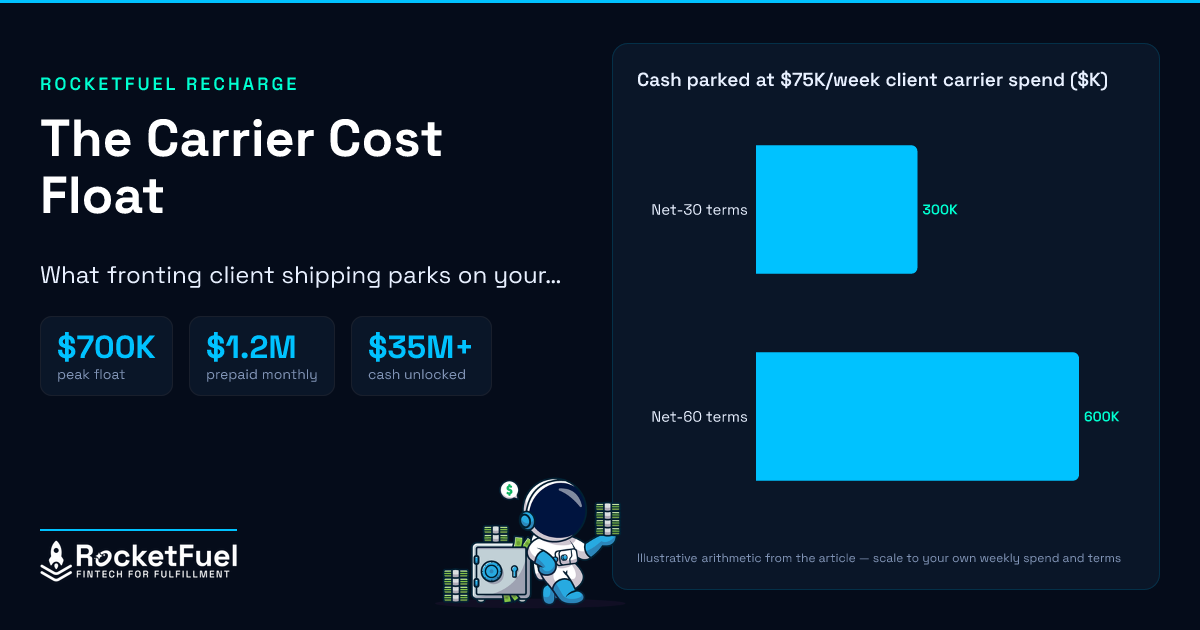
Start with the arithmetic, using an illustrative example. Say your clients generate $75,000 a week in UPS and FedEx spend, and they pay on net-30. By the time the first carrier invoice settles, roughly four weeks of spend has stacked up.
That is about $300,000 parked in other people's shipping, all year round. The number is made up; the structure is not. Scale it to your own weekly spend and your own client terms, and the result is rarely smaller. Run the same numbers at net-60 and the parked figure doubles.
That parked cash is working capital you can't put into racking, labor, software, or new accounts. So most operators borrow it back on a line of credit. The billing platform Loop puts it plainly: most 3PLs rely on bank credit lines, and they often have to float money to carriers while waiting on payment from shippers. The interest is real money, and it grows with your volume. You are paying a bank for the privilege of acting like one.
The cost that never hits a statement
There is also a fragility cost that never shows up on a statement. A slow-paying client doesn't just dent your margin; they decide when your money moves. One stretched receivable during peak and you are choosing between the carrier bill and payroll.
What peak season does to the number
Peak season multiplies the exposure. Here is a RocketFuel Recharge customer outcome that shows the scale: Launch Fulfillment carried $700K in carrier float over a single Black Friday weekend, paid out of Launch's own cash. The Launch Fulfillment case study also tracks what happened after the model changed: $1.2M/month in carrier costs flipped from float to prepaid.
The growth you turn down
The quiet cost is the growth ceiling. Every new client adds carrier spend you'll be floating until their first payment lands. Sign a big account and your working capital requirement jumps the day they start shipping. Operators have turned down good business because the math didn't work. The levers that improve 3pl cash flow reach wider than shipping spend, but no single lever is bigger than this one.
Get paid before you pay: the prepaid metering model
The fix is a sequence change: get paid before you pay carriers. Instead of billing shipping after the fact, the client funds a prepaid balance up front, and every label deducts from that balance the moment it generates.
You bill at month-end and wait out net terms before the cash lands.
Each client funds a balance up front; every label draws from it the instant it prints.
Your own cash carries other people's shipping while a credit line covers the gap.
Clients fund their own shipping in advance, so their money is in place before the carrier's leaves.
Every new account you sign deepens the gap, because the exposure scales with volume.
Your markup is collected at the same moment as the carrier's money, one shipment at a time.
RocketFuel built the Recharge Meter around exactly this model. It runs in four steps:
- Fund. The client loads the meter by ACH or card and sets a recharge amount and threshold. A typical setup: recharge $10,000 when the balance drops below $1,000.
- Deduct. Shipments draw down the balance in real time as labels generate, markup included.
- Auto-recharge. Before the balance runs dry, the recharge fires. Balance falls to $950, the card charges $10,000, and the new balance is $10,950.
- Payout. Funds land in your account within days. RocketFuel never holds your money or stores card data.
Two details matter operationally. The threshold does the safety work, replenishing the balance before it can hit zero, so labels keep printing mid-shift. And markup rides inside each deduction, so your margin is collected at the same moment as the carrier's money, not sixty days later.
What actually disappears
Notice what disappeared: the reimbursement loop. No carrier invoice sits waiting on net terms, because the money was already in place when the label printed. You are no longer collecting your biggest pass-through cost after the fact. It collects itself, in advance, per shipment.
Across its customers, RocketFuel reports $35M+ in cash unlocked. That is the platform's own running metric, not an industry statistic. Braden DiCristofano, CEO of Launch Fulfillment, described the switch this way: "Implementing RocketFuel Recharge instantly boosted our cash flow — virtually overnight." Steve Thomson, CEO of Sweetwater Logistics, says the same thing from the operator's chair, with a caution attached: cash management moves "from a position of deficit to a position of abundance," a shift he says must be respected and prepared for.
Not a loan, not factoring
To be precise about what this is: prepaid metering is not a loan, and it is not factoring. Nothing is financed, and nobody buys your receivables. The order of payment changes; the work stays the same.
The other ways out - and what they trade away
Prepaid metering is not the only way out of the float, but every alternative trades something away. Four routes come up in most conversations.
The meter that reverses the order
Recharge Meter collects client money before each label prints, so the carrier's pull no longer leads your reimbursement.
A bigger line of credit. The bank covers the gap, and you pay interest to carry other people's shipping. The line also has to keep growing as you do, because the exposure scales with volume. And when credit tightens, the renewal conversation happens on the bank's schedule, not yours. RocketFuel's case study of Launch Fulfillment puts the pattern bluntly: the traditional 3PL answer is "raise more credit" or "renegotiate net terms," and both fight the symptom.
Factoring and invoice financing. Selling receivables gets you cash now, but the fee comes out of margin on every invoice you sell, forever. Fulfillment margins are thin to begin with. Factoring also scales badly: the more you grow, the more you sell, the more fees you pay.
Negotiating carrier payment terms. Large shippers sometimes win longer terms from carriers. It helps at the edges. The days move a little, the gap shrinks a little, and the structure stays exactly the same. You are still the one in the middle.
Client deposits and shorter terms. A deposit cushions the exposure, and shorter net terms narrow it. Both genuinely help. Both also strain client relationships when pushed hard, and neither changes who pays the carrier first.
Metering wins on mechanism, not adjectives. It is the only option on this list where client money arrives before carrier money leaves. If the goal is to stop fronting carrier costs rather than refinance them, only one route changes the order of payment. And if tooling is your open question, how to automate 3pl billing covers the implementation side.
How to move clients off the float
Moving clients off the float is a sequencing problem, not a sales problem. Most 3PLs that try to flip every client at once create the standoff they fear. Take it in order instead.
Implementing RocketFuel Recharge instantly boosted our cash flow — virtually overnight.
Start with new clients. Write prepaid carrier billing into every new contract, starting today. A new client has no old habit to defend; the model is simply how you bill. You stop floating new business from day one, and your book gets healthier with every signing.
Give existing clients the why. E-commerce brands live on cash conversion themselves, so speak their language. When shipping money arrives before the carrier pulls it, you can hold rates steadier and absorb their growth without flinching. Your order-to-cash cycle is their stability too. Put it in those terms and the change reads as operational maturity, not distrust. The pitch lands best with a date attached: name the quarter the change takes effect and give them a full billing cycle of notice.
Use deposits as a bridge. A client who balks at full prepay will often accept a deposit plus shorter payment terms. That narrows the gap while they get comfortable, and you can move them to a prepaid balance at renewal. Contract language matters here: spell out the recharge mechanics, the threshold, and what happens if a charge fails.
Name the switching risks out loud. Some clients will push back, a few may shop the market, and a billing change handled badly costs trust. Be clear-eyed about billing automation risks before you set a timeline, and honest with yourself about when to automate 3pl billing versus when to fix process first.
Sequence it this way and the exposure shrinks client by client, with no hard conversation forced before you're ready.
FAQ
Is fronting carrier costs the same as a fronting carrier in insurance?
No. In logistics it describes a billing problem: you pay UPS or FedEx for client shipping, then wait weeks for reimbursement. In insurance, a fronting carrier is a licensed insurer that issues a policy while a captive or reinsurer holds the risk, which is a regulatory arrangement with no connection to billing. The two senses share a word and nothing else.
How does prepaid billing improve order-to-cash?
It removes the longest wait in the cycle. In the classic model you do the work, bill at month-end, then sit through net terms before the cash lands. With a funded balance, shipping money is collected before the label prints, so the gap on your biggest pass-through cost closes entirely. What's left to collect is your own fulfillment revenue, a smaller and steadier number.
Is prepaid billing a hard sell to clients?
Sometimes, yes. Clients accustomed to net terms can read prepay as distrust, so the framing matters. That is why the rollout above starts with new clients and uses a bridge period for existing ones. In practice the conversation is easier than most operators expect. You are asking clients to fund their own shipping in advance, not to pay your bills, and most reasonable brands get that. Expect a handful of questions about fees and failed charges, and answer them in the contract rather than ad hoc.
Ready to stop fronting carrier costs? Get a demo and see the Recharge Meter run against your own client mix, your own carriers, and your own peak. You did the work. Get paid before you pay for it.
More in Billing & Cash Flow
The plain definition: five standard charge buckets, pass-through vs markup on the shipping line, and the five-step loop that turns warehouse activity into paid bills.
Billing & Cash Flow · 9 min read How to Improve 3PL Cash Flow: Five Levers, Ranked by ImpactFive ranked levers for the operator's cash gap: who funds shipping, faster and cleaner bills, tighter terms and collections, carrier refunds, and cost discipline.
Billing & Cash Flow · 8 min read When Should a 3PL Automate Billing? The Five Readiness ThresholdsScore yourself on five thresholds you can read off your own operation — including the cases where staying manual is the right call for now.
Ready when you are
See it run on your operation.
30-minute live demo. We'll walk your billing model against the Recharge Meter and run the math on your last 90 days.
- Live demo, not a sales deck
- We run your last 90 days
- Built by 3PL operators