
Billing & Cash Flow
How to Improve 3PL Cash Flow: Five Levers, Ranked by Impact
Payroll and carrier bills leave fast; client money comes back slow. Five levers close the gap — ranked by impact, because a reminder email and the funding model do not move the same money.
How to Improve 3PL Cash Flow: Five Levers, Ranked by Impact
Improving 3PL cash flow is the work of shortening the gap between the day money leaves your warehouse and the day client payments arrive. Payroll and carrier invoices go out fast; client money comes back slow. Five levers close that gap. This guide ranks them by impact, starting with the structural one.
Why 3PL cash flow breaks: the operator's cash gap
3PLs run short on cash because the business pays for everything before it gets paid for anything. Your cash conversion cycle is the count of days between paying for wages, space, and freight and collecting the matching revenue from clients. In this business it runs long by design: your costs clear weekly while client money rides 30- to 60-day terms.
The gap in one week
Here is the gap in one week, with illustrative numbers — an example, not industry data. You ship 5,000 orders at an $8 average label. The carrier bills roughly $40,000 against those labels, and that cash leaves your account within a week or two. Friday payroll clears the same week. The bill for that work goes out at month-end and pays around day 45.
Run it forward and you are covering about six weeks of shipping and wages before the first dollar comes back. Scale the example to 20,000 orders and the same arithmetic holds — the wedge just gets four times heavier. The gap is a structural feature of the work, not a sign you are running the warehouse badly.
The squeeze grows with volume, which is the cruel part: winning a big new client makes cash flow worse before it makes revenue better. Working capital in this business is mostly other people's timing — your clients' terms on one side, your carriers' and landlords' on the other.
Why the ranking matters
Most advice on how to improve 3PL cash flow ignores that structure. Half of it is written to your clients — the brands choosing a 3PL — not to you, the operator making payroll. And most 3PL cash flow management guidance lists co-equal tips, as if a reminder email and the funding model moved the same money.
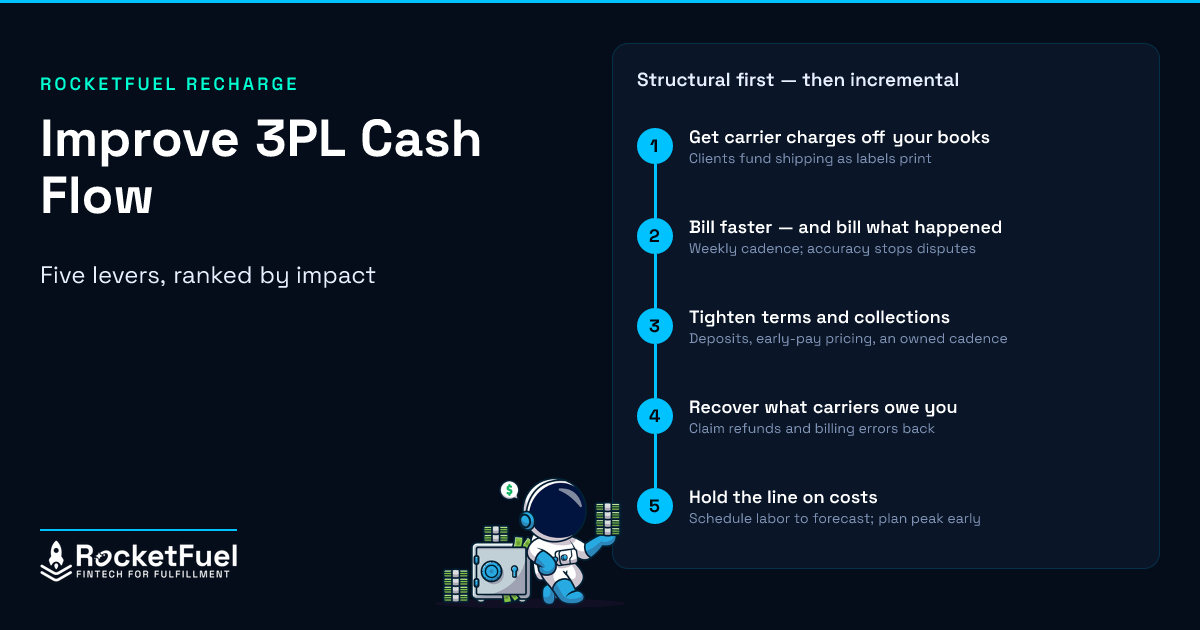
They do not, and the ranking below says so out loud. Every lever shortens the cash conversion cycle at a different point, but only one is structural — it changes who funds shipping. The rest are incremental: they speed cash flow up inside a gap that stays the same shape. In order of impact:
- Get carrier charges off your books.
- Invoice faster — and bill what actually happened.
- Tighten payment terms, deposits, and collections.
- Recover the money carriers owe you.
- Hold the line on wages and seasonal spending.
Levers four and five share the final section below, because both are leak-plugging rather than structure.
Lever 1: Stop fronting carrier costs
Carrier charges are the heaviest drag on 3PL cash flow in most warehouses, and who funds them is the biggest single lever you have. Shipping is usually the largest cost you pay on clients' behalf: UPS and FedEx bill weekly on short payment terms, while clients reimburse those same labels 30 to 60 days later. In between, you float the carrier bill out of your own working capital — every label, every week.
The structural fix is to get paid as you ship: clients fund shipping from a prepaid balance as labels print, so you are paid before you pay the carrier.
The mechanics fit in one sentence, quoted from the RocketFuel Recharge site: "RocketFuel reads carrier cost at label generation and deducts it — plus your markup — in real time, so cost and margin are visible per shipment." The Recharge Meter is the tool that does it; the full model — pricing, client conversations, rollout — is the dedicated guide's territory, not this one's.
The proof is RocketFuel customer data, not an industry survey. Customers have moved more than $35M of cash out of the float — a figure RocketFuel reports as customer outcomes across its base. In the Launch Fulfillment case study, getting paid first looked like $1.2M/month in carrier costs flipped from float to prepaid, and a line of credit that went from lifeline to operating reserve.
Impact: the highest on this list, because this lever removes the funding gap rather than shrinking it. No other single change moves cash flow as far. Effort: real — this is a commercial change, not just tooling, and your clients need the why before they fund the what. That trade is the whole argument for ranking: structural beats incremental because it stops the leak at the wall, not at the mop.
Lever 2: Invoice faster - and bill what actually happened
Invoicing speed sets when the payment clock starts; billing accuracy decides whether the bill gets paid without a fight. Both are pure cash levers, and both are fixable without renegotiating a single contract.
Work you did for free is the most expensive kind.
Cadence first. If you bill monthly, work done on the 3rd waits four weeks before terms even start running. Weekly invoicing pulls the whole receivable forward — same clients, same rates, same work, sooner money. Speed is cash flow with no new sales attached.
Accuracy is the quieter lever
Accuracy is the quieter half. An invoice that reflects what actually happened — every pick, every kit, every dimensional-weight correction the carrier re-billed you — gets approved and paid. An invoice with one wrong line gets queried, and a queried bill ages while the work it covers goes stale. Billing accuracy is a cash lever disguised as bookkeeping.
Where charges disappear in transit
Your WMS already captured the activity; the problem is the relay. The WMS knows what happened, a spreadsheet prices it, and an accounting tool sends the bill — three hand-offs where charges leak and days disappear. Closing that relay shortens your order-to-cash gap at both ends: capture to bill, and bill to paid. Accessorials are the classic casualty: the charge happened on the floor, nobody keyed it, and the month closed without it. Work you did for free is the most expensive kind.
Two neighboring guides own the depth here. For the charge-type groundwork, start with what is 3pl billing. When you are ready to take cadence and accuracy off a human's plate, automate 3pl billing covers the rollout. Automated invoicing is the move; the how lives there, not here.
Impact: medium-high, in proportion to how slow and loose your current bills are. Effort: low for cadence — it is a calendar decision — and medium for accuracy, which is a data-capture fix. Both compound with lever one: faster money matters more when none of it is plugging a shipping hole.
Lever 3: Tighten payment terms, deposits, and collections
Offer the shortest payment terms your client relationships will genuinely bear — net-30 as the default, tighter for new or shaky accounts — and price anything longer as a concession instead of a default. The metric to manage is days sales outstanding (DSO): the average number of days between billing a client and the cash actually landing.
Price the structural lever first
See what getting paid at label print, instead of waiting on receivables, costs as a share of your revenue.
Three standing structures cut DSO without turning you into a debt collector:
- A deposit up front. Take first-month prepay on every new account. It buffers your receivables and quietly filters out the clients who planned to pay late from day one.
- Early payment pricing. A small discount for paying within ten days turns clients who can pay early into clients who do. Price it deliberately — keep the discount cheaper than the interest on a credit line.
- A collections cadence. A reminder before the due date, a call after it, the same rhythm every cycle. Accounts receivable that nobody owns becomes accounts receivable that nobody chases.
Friction is a hidden DSO driver
Cut payment friction while you are at it: ACH pull or card on file beats waiting on a check run. None of this requires new software on day one. It requires a default, a calendar, and the nerve to enforce both with your best clients as well as your worst. Move disputes into the same rhythm, too.
A disputed line stalls the whole bill, so resolve disputes against the activity record quickly and credit what you owe on the next cycle. Net-30 on paper drifts toward net-45 in practice unless someone owns the chase. Every day shaved off DSO is cash flow pulled forward into the quarter you are actually living in.
Impact: medium — real and recurring, but it tunes the existing model rather than changing who funds what. Effort: low to medium; the hard part is holding the line with your largest clients. Generic finance advice starts and ends here. It sits third because tighter terms only speed up repayment of money you should never have been out in the first place.
Lever 4: Plug the slow leaks - carrier refunds, labor, and peak season
Yes — you can recover money from carriers. Refunds for service failures on guaranteed services and billing errors are owed under your carrier agreements, and they are paid only when you claim them. This section holds levers four and five: recovery, which is claiming that money, and cost discipline — labor and seasonal surge spending that hurt cash flow when payroll runs ahead of the revenue it serves. Neither is structural. Both are real.
What carrier refunds recover
Recovery is proven at operator scale. Launch Fulfillment — the same RocketFuel customer from the case study above — recovers $250K+/year in carrier billing errors, a customer outcome RocketFuel reports, not an industry benchmark.
Checking carrier bills by hand stops scaling at a few hundred shipments a week, which is why parcel audit software exists as a category; what the tools are and how they compare is that guide's territory. The cash flow framing is the only part that belongs here: a refund you never claim is margin you earned and handed back.
Labor and peak-season discipline
On the cost side, labor is your largest controllable spend. Schedule it against forecast volume so payroll tracks revenue instead of running ahead of it — idle hours in a slow week burn the same cash as busy ones.
Peak season then cuts both ways: more orders, but surge staffing, overtime, and client inventory arriving early. That inventory is not yours to sell, but it fills billable racks weeks before its orders ship. Bill the storage, and plan Q4 cash in late summer — the spend always arrives before the revenue does.
Impact: low to medium individually, additive together. Effort: low — these are habits and a calendar, not a new operating model. They round out the ranking; they do not lead it.
FAQ
What is the best way to improve cash flow?
For a 3PL, the honest answer is ranked, not generic. The structural move comes first: get carrier charges funded by clients as labels print, because that is what creates the gap. Then bill faster and more accurately, tighten terms and collections, and claim what carriers owe you back. Generic advice leads with invoicing cadence; for cash flow in a warehouse, the funding model outweighs it.
How does a 3PL make money?
A 3PL earns margin on services: storage billed by space and time, handling billed per order and per item, and shipping passed through at cost or marked up. The margins are workable but thin, and they arrive on a delay — which is why cash timing, not just profitability, decides how comfortably a warehouse grows.
Wherever you start, the structural lever is the one worth pricing first: run your numbers in RocketFuel's ROI calculator and see what getting paid at label print, instead of waiting on receivables, costs as a share of your revenue.
More in Billing & Cash Flow
What the gap between carrier terms and client terms really costs a 3PL — and the prepaid model that collects shipping money before the label prints.
Billing & Cash Flow · 7 min read What Is 3PL Billing? Charges, Models, and the Billing ProcessThe plain definition: five standard charge buckets, pass-through vs markup on the shipping line, and the five-step loop that turns warehouse activity into paid bills.
Billing & Cash Flow · 8 min read When Should a 3PL Automate Billing? The Five Readiness ThresholdsScore yourself on five thresholds you can read off your own operation — including the cases where staying manual is the right call for now.
Ready when you are
See it run on your operation.
30-minute live demo. We'll walk your billing model against the Recharge Meter and run the math on your last 90 days.
- Live demo, not a sales deck
- We run your last 90 days
- Built by 3PL operators